Vision plays a pivotal role in a child’s development, learning, and quality of life.
Yet many children’s eyesight problems go undetected until they cause more serious issues. That’s why routine eye exams at key ages are vital.
These checkups provide early detection of vision problems—such as Refractive errors, eye alignment issues, and amblyopia—and help ensure children grow with healthy vision.
Recommended Age-Based Schedule for Paediatric Eye Exams
6 Months (or by 12 Months)
The first comprehensive eye exam should ideally take place between six and twelve months of age.
At this stage, the eye doctor will assess eye alignment, check for clarity of the optic media (i.e., the lens and cornea), and look for signs of congenital eye abnormalities or conditions that can affect visual development.
Early detection and intervention are critical because some developmental pathways in vision can be more easily corrected when the brain’s visual system is still maturing.
Age 3 (Between 3 and 5 Years)
Before entering school, children should receive another full eye exam between ages three and five.
This helps identify early refractive issues (like farsightedness or astigmatism), eye alignment problems (e.g. strabismus), or amblyopia (“lazy eye”).
At this developmental stage, treatments like patching or exercises can be especially effective if started early.
Preschool / Pre‑School Entry
A thorough eye exam just before starting school is vital.
Children at this age begin to rely heavily on vision for reading, writing, and learning new tasks.
Detecting and correcting vision problems before or early in their school years can help prevent difficulties in reading, learning, or classroom participation.
School Age (6 Years and Beyond)
Once children begin school, annual eye exams are often recommended, especially in the early grade years, when near-sightedness (myopia) often first appears.
At some point, after a stable visual baseline is established, the frequency might safely shift to once every one to two years if vision correction isn’t needed and there are no other risk factors.
However, for children who already wear glasses or contact lenses, exams should remain at least once a year, or as recommended by their eye care professional.
What Happens During a Pediatric Eye Exam?
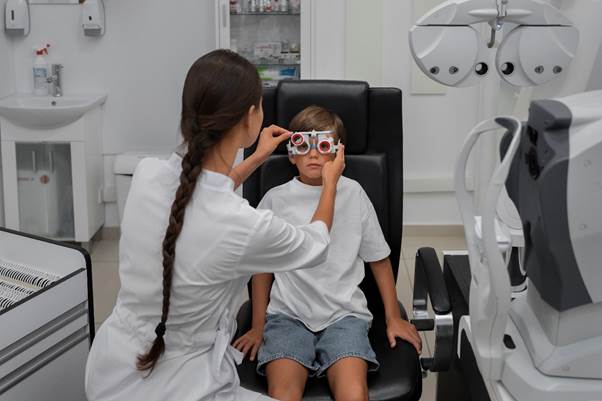
Eye exams for children are adapted to their age and ability but generally include:
- Visual Acuity & Alignment Tests
The doctor checks how clearly the child can see (sharpness of vision) and how well the eyes are working together.
For younger children who cannot yet read an eye chart, photoscreening or other age‑appropriate vision tests may be used.
- Eye Health & Internal Examination
The eye care professional examines the retina, optic nerve, pupil, lens, and other internal structures.
They may dilate the pupils with eyedrops to allow a clearer view of the internal eye structures.
- Eye Movement & Coordination Assessment
The doctor evaluates how smoothly the eyes move together, tracking ability, and coordination.
These tests indicate whether there are muscle or alignment issues.
By combining these assessments, the eye doctor builds a baseline understanding of a child’s visual health—critical for detecting any deviations as the child grows.
Why Early & Regular Eye Exams Matter
- Prevent Developmental Impacts
Vision problems can subtly interfere with reading, school performance, coordination, or play. When left untreated, they may hamper development in ways that are harder to reverse later.
- Treat Amblyopia (Lazy Eye) Early
Amblyopia, sometimes called “lazy eye,” is best treated in early childhood. If left too long, the brain may permanently favor the stronger eye, making correction much more difficult or even impossible in later years.
- Track Changes Over Time
Regular exams help establish a child’s visual baseline. This lets eye care providers better detect deviations in vision, changes in eye health, or progression of myopia or other conditions.
- Address Refractive Errors
Nearsightedness, farsightedness, or astigmatism can all affect how a child perceives the world. Corrective prescription lenses, early treatment, or vision therapies can help children see clearly and perform better in school.
- Improve Quality of Life
Good vision supports a child’s confidence, participation in sports or extracurriculars, and social interaction. Ensuring visual health supports overall well-being.
Tips for Parents: Maximizing the Benefit of Eye Exams
- Schedule appointments at the recommended ages—even if your child seems to see fine.
- Bring previous prescriptions (if any), any concerns or observations (squinting, eye rubbing, head tilting), and your family’s eye health history.
- Ensure your child has had minimal screen strain before the test (resting eyes if needed).
- Ask your eye care provider what signs to watch for between visits (e.g. excessive blinking, head tilting, complaints of double or blurred vision).
- Adhere to follow-up visits and recommended treatments (e.g. glasses, patching, exercises).
See the World Clearly — Start Early
Vision is the foundation for learning, development, and daily life. Skipping or delaying eye exams can allow small vision issues to become significant problems. Early detection, consistent monitoring, and timely treatment help children grow with confidence and clarity.
👉 Book your child’s eye exam today at A-One Ultrasound & Eye Care!
Safeguard their vision and set them up for success—from toddler steps to academic milestones.